

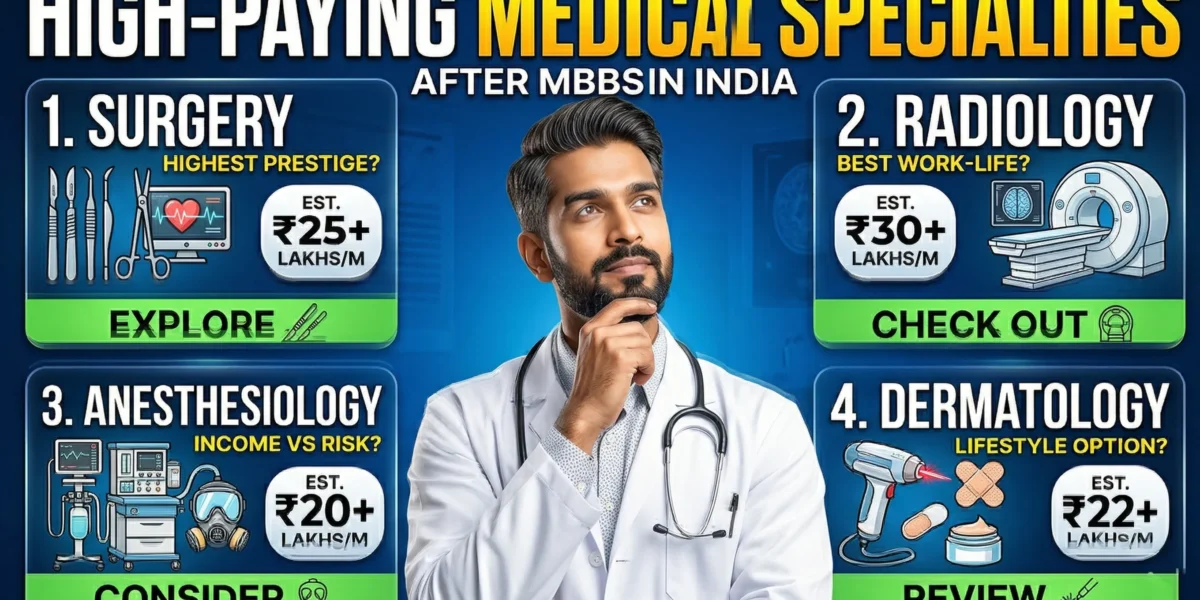
Completing MBBS is one of the hardest academic achievements in India. But for most doctors, it is not the destination — it is the starting line.
Table of Contents
The medical specialization you pursue after MBBS through NEET-PG determines everything that follows: your daily clinical work, your earning potential, your lifestyle, your research opportunities, and ultimately the kind of doctor you become.
India’s healthcare sector is undergoing rapid expansion — corporate hospital chains, medical tourism, telemedicine, and super-specialty care are all growing simultaneously. This growth is creating a significant demand-supply gap in specialist doctors, which directly translates into premium salaries for the right specializations.
This guide ranks the top high-paying medical specializations after MBBS in India, with honest salary data, career scope, NEET-PG competitiveness, and the super-specialty (DM/MCh) pathway for each — so you can choose the specialty that maximises both your passion and your earning potential.
How Medical Specialization Works After MBBS
After MBBS, doctors pursue postgraduate specialization through:
- MD (Doctor of Medicine): Non-surgical specialties — Radiology, Dermatology, Cardiology (pre-DM), Anaesthesiology, Pathology, Psychiatry, Paediatrics, General Medicine, etc.
- MS (Master of Surgery): Surgical specialties — Orthopaedics, General Surgery, ENT, Ophthalmology, Obstetrics & Gynaecology, etc.
- Diploma Courses: 2-year programmes (DNB, Diploma in Anaesthesia, DMRD, etc.)
NEET-PG is the single entrance exam for all MD/MS/Diploma admissions in India, conducted by the National Board of Examinations (NBE). Your NEET-PG rank determines which specialty and which college you can access.
Top High-Paying Medical Specializations After MBBS
1. Radiology (MD Radiology / DMRD) — The Highest-Demand, Highest-Paying Specialty
Average Salary: ₹3 – ₹8 LPM (Lakh Per Month) for established radiologists Government Salary: ₹1.5 – ₹3 LPM (senior radiologist scale) NEET-PG Competitiveness: Extremely high — top 500–1,500 rank (government colleges)
MD Radiology has emerged as the single most sought-after MD specialization in India — and for excellent reason. Radiologists are required for every patient diagnosis across every department, yet India has a severe shortage of qualified radiologists (approximately 1 radiologist per 1,00,000 population against the WHO norm of 1 per 10,000).
Why the salary is exceptional:
- Radiologists interpret CT scans, MRIs, X-rays, PET scans, and interventional procedures
- Private hospitals pay premium retainer fees for radiologists
- Tele-radiology allows radiologists to report remotely — serving multiple hospitals simultaneously, multiplying income dramatically
- No emergency calls, more predictable lifestyle vs surgical specialties
Career Ceiling: Interventional Radiology (IR) subspecialty commands ₹5–15 LPM in corporate hospitals. Tele-radiology entrepreneurs earn ₹10–30 LPM.
2. Dermatology (MD Dermatology, Venereology & Leprology — DVL)
Average Salary: ₹2 – ₹6 LPM (private practice) Government Salary: ₹1 – ₹2 LPM NEET-PG Competitiveness: Very high — top 200–800 rank
MD DVL (Dermatology) is consistently among the top 3 most competitive NEET-PG branches because of its extraordinary lifestyle-income combination. Dermatologists in metro cities with cosmetic practice earn incomes that rival surgical super-specialists.
Why the salary is exceptional:
- Cosmetic dermatology (laser, fillers, Botox, PRP, chemical peels) generates very high per-procedure revenue
- No emergency calls, no night duties, predictable OPD practice
- Growing demand driven by rising skin awareness, pollution-related skin conditions, and India’s booming aesthetic medicine market
- Multiple revenue streams: clinical dermatology + cosmetic + trichology (hair loss)
Career Ceiling: Cosmetic dermatologists with established clinics in tier-1 cities earn ₹5–12 LPM. Fellowship in Dermatosurgery or Aesthetic Medicine further expands scope.
3. Orthopaedics (MS Orthopaedics)
Average Salary: ₹2 – ₹7 LPM (established orthopaedic surgeon) Government Salary: ₹1.2 – ₹2.5 LPM NEET-PG Competitiveness: Very high — top 300–1,200 rank
MS Orthopaedics is India’s most in-demand surgical specialty, driven by an ageing population, rising sports injuries, road accident trauma, and the explosive growth of joint replacement and spine surgery.
Why the salary is exceptional:
- High-value procedures: Total Knee Replacement (TKR), Total Hip Replacement (THR), spine surgery, arthroscopy
- Corporate hospitals pay orthopaedic surgeons among the highest specialist retainers
- Sports medicine subspecialty (IPL team doctors, elite sports) is a premium niche
- Implant-linked income and OPD consultation volume both high
Career Ceiling: Fellowship in Arthroplasty (joint replacement) or Spine Surgery through centres in India, UK, Germany, or USA commands ₹5–12 LPM at senior levels.
4. Cardiology (DM Cardiology after MD General Medicine)
Average Salary: ₹4 – ₹12 LPM (interventional cardiologist) Government Salary: ₹2 – ₹4 LPM NEET-PG / SS Competitiveness: Ultra-high — requires MD Medicine + DM Cardiology (additional 3 years)
DM Cardiology is India’s highest-paying super-specialty — but it requires a longer pathway: MBBS → MD General Medicine (3 years) → DM Cardiology (3 years) = 6 years post-MBBS.
Why the salary is exceptional:
- Interventional cardiologists performing angioplasties, stenting, and EP studies are among the highest-earning doctors in India
- Heart disease is India’s leading cause of death — demand is enormous and growing
- Cath lab procedures command extremely high per-procedure fees
- Corporate hospitals offer revenue-sharing models for high-volume interventional cardiologists
Career Ceiling: Top interventional cardiologists at corporate hospitals in metro cities earn ₹10–25 LPM. Many establish independent cath lab partnerships for even higher income.
5. Plastic Surgery (MCh Plastic Surgery)
Average Salary: ₹3 – ₹10 LPM (cosmetic + reconstructive practice) Government Salary: ₹1.5 – ₹3 LPM Competitiveness: High — MCh after MS General Surgery
MCh Plastic Surgery covers both reconstructive surgery (burns, trauma, cancer reconstruction) and the rapidly growing field of cosmetic surgery in India. With medical tourism fuelling demand for aesthetic procedures and increasing disposable incomes, plastic surgeons are among the fastest wealth-building specialists in Indian medicine.
Career Ceiling: Cosmetic surgery practices in metro cities with a strong digital presence command ₹5–15 LPM. Hair transplant subspecialization adds a significant parallel income stream.
6. Ophthalmology (MS Ophthalmology)
Average Salary: ₹1.5 – ₹5 LPM Government Salary: ₹1 – ₹2 LPM NEET-PG Competitiveness: High — top 800–2,500 rank
MS Ophthalmology offers an outstanding work-life balance + income combination — making it among the most consistently chosen surgical specialties at NEET-PG. India’s cataract surgery load is the largest in the world, and phacoemulsification surgeons in tier-2 and tier-3 cities build thriving practices rapidly.
Career Ceiling: Vitreo-retinal surgery and LASIK/refractive surgery subspecialization in metro cities earns ₹3–7 LPM. Dr. Agarwal’s, Sankara Nethralaya, and LV Prasad Eye Institute chains offer structured high-income employment.
7. Anaesthesiology (MD Anaesthesiology)
Average Salary: ₹2 – ₹5 LPM Government Salary: ₹1.2 – ₹2.5 LPM NEET-PG Competitiveness: Moderate to high — top 2,000–6,000 rank
MD Anaesthesiology is critically underappreciated as a high-paying specialty. India faces an acute shortage of anaesthesiologists — there are fewer than 15,000 practising anaesthesiologists for a population of 1.4 billion — making it one of the most employment-secure specialties in Indian medicine.
Why the salary is rising fast:
- Every surgical procedure requires an anaesthesiologist — they are irreplaceable
- Pain management and critical care subspecialization (ICU) adds significant income
- Corporate hospitals offer revenue-sharing models for busy OT anaesthesiologists
- Consultant anaesthesiologists covering multiple hospitals earn ₹3–6 LPM
Quick Salary Reference: Top Medical Specializations
| Specialization | Degree | Avg. Private Salary | NEET-PG Rank Needed |
|---|---|---|---|
| Radiology | MD | ₹3 – ₹8 LPM | Top 500–1,500 |
| Cardiology | DM (after MD) | ₹4 – ₹12 LPM | Ultra competitive |
| Dermatology | MD DVL | ₹2 – ₹6 LPM | Top 200–800 |
| Plastic Surgery | MCh | ₹3 – ₹10 LPM | Competitive |
| Orthopaedics | MS | ₹2 – ₹7 LPM | Top 300–1,200 |
| Ophthalmology | MS | ₹1.5 – ₹5 LPM | Top 800–2,500 |
| Anaesthesiology | MD | ₹2 – ₹5 LPM | Top 2,000–6,000 |
How to Choose the Right Medical Specialization
Three questions that should guide your decision:
1. What is your aptitude — medical or surgical? If you thrive on procedures, precision, and operating theatre — MS/MCh surgical specialties. If you prefer diagnosis, long-term patient management, and cognitive medicine — MD specialties.
2. What lifestyle do you want? Dermatology, Radiology, and Ophthalmology offer predictable hours with high income. Cardiology, Neurosurgery, and Plastic Surgery offer higher income ceilings with greater time intensity, especially in early career.
3. What is your realistic NEET-PG rank? Be honest about this. Pursuing Radiology at 5,000 rank (when government seats require top 1,500) means expensive private college fees that severely delay ROI. A well-chosen alternate specialty at your actual rank may build greater long-term wealth.
Frequently Asked Questions
Q. Which medical specialization has the highest salary in India? Interventional Cardiology (DM) and Radiology consistently top salary charts. Established interventional cardiologists at corporate hospitals earn ₹10–25 LPM. Senior radiologists with tele-radiology contracts earn ₹8–20 LPM. Cosmetic Dermatology and Plastic Surgery follow closely.
Q. Which MD specialization is easiest to get with a moderate NEET-PG rank? MD Anaesthesiology, MD Pathology, MD Psychiatry, and MD Community Medicine are relatively more accessible at moderate NEET-PG ranks (3,000–10,000 range for government seats) while still offering strong career pathways — especially Anaesthesiology with its acute shortage and rising salaries.
Q. Is a super-specialty (DM/MCh) necessary for a high salary after MBBS? Not for all specialties. MD Radiology, MD DVL, and MS Orthopaedics command very high salaries without an additional super-specialty. However, for Cardiology, Neurology, and Gastroenterology, DM adds significant earning and career differentiation.