
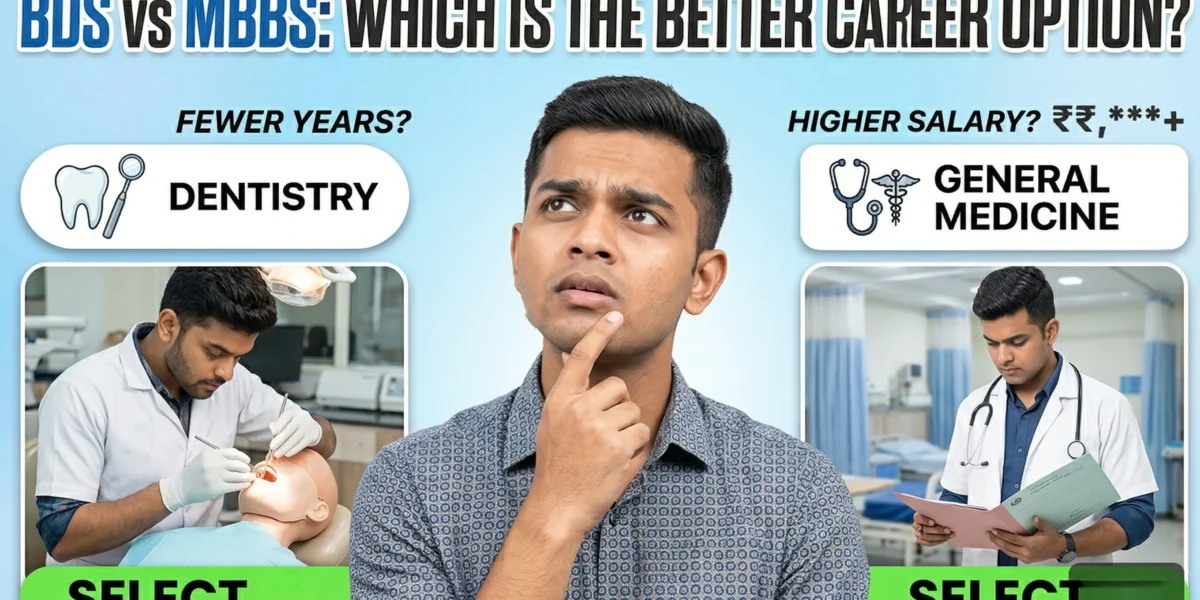
Every year, after NEET results are declared, lakhs of students face a critical fork in the road: MBBS or BDS?
Table of Contents
For many, MBBS is the dream — but NEET scores, seat availability, and skyrocketing private college fees make BDS a serious, strategic alternative. For others, BDS is the genuine first choice — a focused, specialized medical career with excellent private practice potential.
The problem? Most students make this decision based on social perception rather than career data. “MBBS sounds better” is not a career strategy. Understanding the real differences in duration, fees, salary, scope, government jobs, and postgraduate options is.
This guide gives you exactly that — a clear, honest, data-backed comparison of BDS vs MBBS so you can choose the career that actually fits your goals, not just your rank.
BDS vs MBBS: The Fundamental Difference
| Parameter | MBBS | BDS |
|---|---|---|
| Full Form | Bachelor of Medicine & Bachelor of Surgery | Bachelor of Dental Surgery |
| Course Duration | 4.5 years + 1 year internship | 4 years + 1 year internship |
| Total Duration | 5.5 years | 5 years |
| Regulating Body | National Medical Commission (NMC) | Dental Council of India (DCI) |
| Entrance Exam | NEET-UG | NEET-UG |
| Government College Fees | ₹10,000 – ₹1,00,000/year | ₹8,000 – ₹80,000/year |
| Private College Fees | ₹10 – ₹25 Lakh/year | ₹3 – ₹8 Lakh/year |
| Postgraduate Route | MD / MS (via NEET-PG) | MDS (via NEET-MDS) |
| Specialization Breadth | Very wide (50+ specialties) | Focused (dental specialties) |
| Government Job Scope | Extensive | Moderate |
| Private Practice Potential | High (general + specialist) | Very High (own clinic) |
Course Duration and Structure: Where BDS Has a Subtle Edge
MBBS runs for 4.5 years of academic study plus a mandatory 1-year rotating internship — totalling 5.5 years before you can register as a licensed physician.
BDS runs for 4 years of academic study plus a mandatory 1-year internship — totalling 5 years before you practice independently as a licensed dentist.
The 6-month difference matters practically. A BDS graduate can open a private dental clinic, clear NEET-MDS, or begin employment half a year earlier than an MBBS graduate. Over a career, that compounding head start in clinical experience and earnings is meaningful.
Both programmes use the same gateway — NEET-UG — making your NEET score the primary determinant of which option is accessible to you at a government college.
NEET Cutoff: BDS vs MBBS Seat Availability
This is where the most consequential practical difference lies for most students:
- MBBS government seats: Approximately 57,000+ across India (highly competitive; general category cutoff at top state colleges requires 580–640+)
- BDS government seats: Approximately 27,000+ across India (less competitive; accessible at lower NEET scores than MBBS government seats)
- MBBS private college fees: ₹50 Lakh – ₹1.2 Crore total (a significant financial burden)
- BDS private college fees: ₹15 Lakh – ₹40 Lakh total (substantially more affordable)
The strategic reality: A student who scores 520–560 in NEET may not secure a government MBBS seat but can comfortably secure a government BDS seat — which costs a fraction of private MBBS and delivers a respected, licensable medical career.
For families where taking a ₹70–90 lakh education loan for private MBBS is financially ruinous, BDS from a government dental college is not a compromise — it is the smarter financial decision.
Career Scope: MBBS vs BDS
MBBS Career Scope
MBBS opens the broadest career canvas in Indian healthcare:
- Government Medical Officer — the most commonly pursued post; state and central government health services
- Hospital Doctor / Resident — across all specialties after PG
- Specialist (MD/MS): Cardiology, Neurology, Orthopaedics, Dermatology, Paediatrics, Surgery — 50+ PG specializations
- UPSC CMS (Combined Medical Services) — one of India’s most prestigious government medical jobs
- Medical Researcher / Academic — via MD, DM, or PhD
- Defence Medical Officer — Army, Navy, Air Force
- Public Health / WHO / NGO roles — national and international
The breadth of MBBS is unmatched. An MBBS graduate can ultimately specialize in virtually any area of medicine and surgery.
BDS Career Scope
BDS is focused — but within that focus, the opportunities are robust and growing:
- Private Dental Clinic (Own Practice) — the most common and financially rewarding path
- Government Dental Surgeon — state dental health services, CHC/PHC postings
- Hospital Dental Department — corporate hospitals, dental chains (Clove Dental, myDentist)
- MDS Specialist: Orthodontics, Oral & Maxillofacial Surgery, Periodontics, Endodontics, Prosthodontics — 9 recognized specializations
- Dental Teaching Faculty — after MDS
- Dental Product Companies — clinical roles at 3M, Dentsply, Ivoclar Vivadent
- Public Health Dentistry — government oral health programmes
- Abroad Practice — USA (NBDE), UK (ORE), Canada, Australia after licensure exams
India’s dental industry is projected to grow at 13–15% annually through 2028, driven by rising dental awareness, cosmetic dentistry demand, and urban dental chain expansion. For BDS graduates, this market growth is directly monetizable through private practice.
Salary Comparison: BDS vs MBBS
MBBS Salary in India (2025)
| Role | Monthly Salary |
|---|---|
| Government Medical Officer | ₹56,100 – ₹1,00,000 |
| Private Hospital Junior Doctor | ₹35,000 – ₹60,000 |
| General Physician (Own Clinic) | ₹80,000 – ₹3,00,000+ |
| Specialist after MD/MS | ₹1,50,000 – ₹5,00,000+ |
BDS Salary in India (2025)
| Role | Monthly Salary |
|---|---|
| Government Dental Surgeon | ₹44,900 – ₹80,000 |
| Corporate Dental Chain Dentist | ₹30,000 – ₹60,000 |
| Own Dental Clinic (established) | ₹80,000 – ₹3,00,000+ |
| MDS Specialist (Ortho, OMFS) | ₹1,00,000 – ₹4,00,000+ |
The honest salary truth: At the entry level, MBBS government medical officers earn slightly more than BDS dental surgeons. But established BDS practitioners with a successful private clinic frequently match or exceed general MBBS physician incomes — because dental procedures (implants, orthodontics, cosmetic dentistry) command high per-procedure fees.
The income ceiling for an MDS Oral & Maxillofacial Surgeon or a high-end cosmetic dentist in a metro city is genuinely competitive with MD specialist income.
Government Jobs: MBBS Has the Clear Advantage
This is one area where MBBS holds a decisive structural advantage over BDS:
MBBS government job pathways:
- UPSC Combined Medical Services (CMS) — Class I gazetted officer
- State Medical Officer posts (Class I/II)
- ESIC, CGHS, Railways, Defence Medical Corps
- AIIMS, PGIMER, JIPMER faculty (after MD/MS)
BDS government job pathways:
- State Dental Surgeon posts (available but fewer vacancies)
- CGHS Dental Officer
- Defence Dental Corps (Army Dental Corps)
- Government Dental College faculty (after MDS)
The volume and variety of government recruitment for MBBS graduates dwarfs what is available for BDS. If job security in the public sector is a priority, MBBS is the stronger qualification by a significant margin.
Postgraduate Options: MD/MS vs MDS
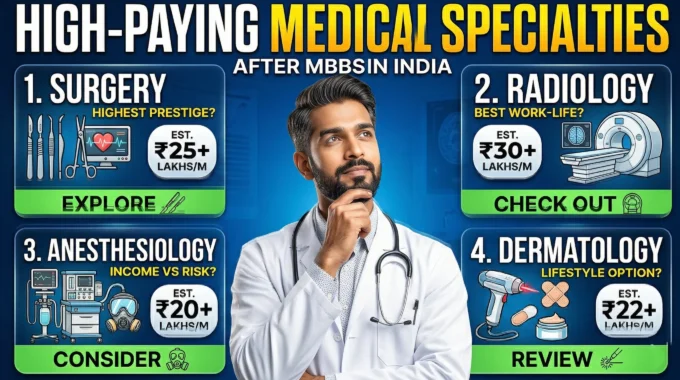
After MBBS: NEET-PG opens the door to MD (Medicine) or MS (Surgery) across 50+ specializations. Top specializations by earning and demand: Radiology, Dermatology, Orthopaedics, Anaesthesiology, Cardiology (DM after MD), Neurosurgery.
After BDS: NEET-MDS leads to MDS (Master of Dental Surgery) across 9 specializations. Highest-demand: Orthodontics, Oral & Maxillofacial Surgery, Prosthodontics, and Periodontics.
Both PG routes are competitive. NEET-PG is more competitive in absolute terms due to higher candidate volume. NEET-MDS is competitive within a smaller pool but high-demand MDS seats (Orthodontics, OMFS) are fiercely contested.
BDS vs MBBS: Which Should You Choose?
Choose MBBS if:
- Your NEET score qualifies for a government MBBS seat — always take it
- Government jobs, UPSC CMS, or defence medical roles are your career goal
- You want the widest possible specialization options at the PG level
- You are prepared financially for private MBBS fees if government seat is unavailable
Choose BDS if:
- Your NEET score qualifies for a government BDS seat but not government MBBS
- Private MBBS fees of ₹60–100 lakh are financially unsustainable for your family
- You are interested in entrepreneurship — owning and growing a dental practice
- Cosmetic dentistry, implantology, or orthodontics genuinely interests you as a specialty
- You are considering international dental practice (USA, UK, Canada, Australia)
Frequently Asked Questions
Q. Is BDS a good career in India in 2025? Yes — particularly for students interested in private practice and entrepreneurship. India’s dental market is growing at 13–15% annually. Established dental practitioners in metro and tier-2 cities earn ₹1–3 lakh per month. MDS specialists in Orthodontics and OMFS command even higher incomes.
Q. Can a BDS graduate do MBBS? No — BDS and MBBS are separate undergraduate programmes. A BDS graduate cannot transfer to or complete MBBS. However, BDS graduates can pursue MDS (postgraduate dental specialization) or certain public health and hospital administration programmes.
Q. Which has more government job opportunities — BDS or MBBS? MBBS has significantly more and better-paying government job opportunities — including UPSC CMS, state medical officer posts, ESIC, CGHS, Railways, and Defence Medical Corps. BDS government opportunities exist but are fewer in number and variety.