

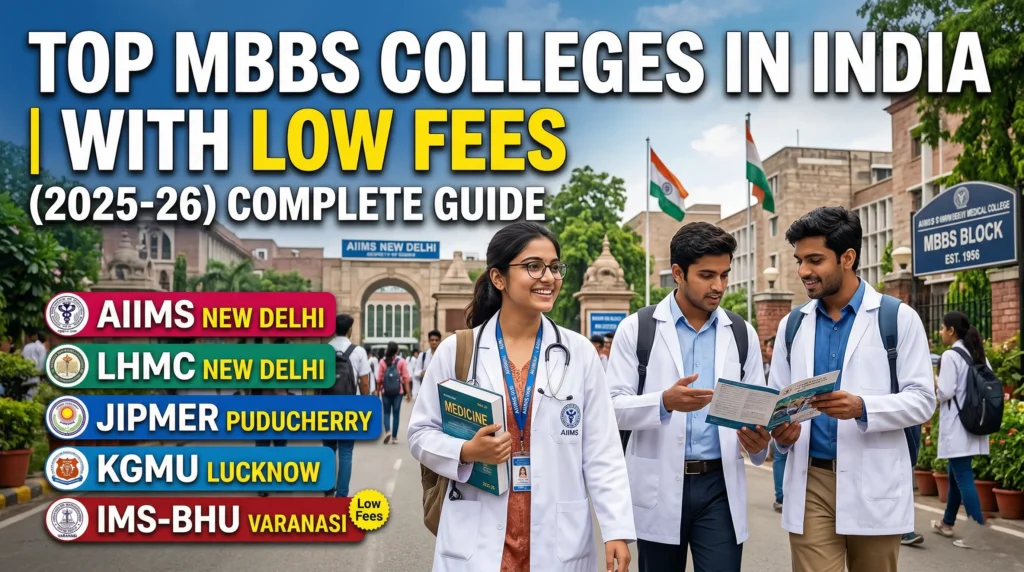
Getting into an MBBS program is one of the most competitive academic achievements in India. Every year, over 22 lakh students appear for NEET-UG — and only a fraction secure seats in government medical colleges where fees remain genuinely affordable. For millions of middle-class and economically weaker families, the MBBS fees structure at a college is just as important as its ranking or infrastructure.
Table of Contents
The good news? India is home to some of the world’s best medical colleges with surprisingly low annual fees — particularly in the central and state government sector. If you secure a good NEET score, you can complete your entire MBBS degree for less than ₹1 lakh in total tuition fees at select institutions.
This guide is designed to help NEET aspirants, parents, and counsellors make informed decisions. We cover the top MBBS colleges in India with low fees, compare fees across categories, explain the admission process, and highlight what factors — beyond fees — you should consider.
Understanding the MBBS Fee Structure in India
Before diving into college lists, it’s important to understand how MBBS fees are structured in India. The total cost of completing MBBS in India depends on:
- Type of college: Central Government, State Government, Deemed University, or Private
- Quota: All India Quota (AIQ) vs. State Quota seats
- Category: General, OBC, SC/ST (fee concessions apply)
- Additional costs: Hostel, mess, books, and miscellaneous charges
Fee Category Breakdown
| College Type | Annual Tuition Fees (Approx.) | Total MBBS Fees (4.5 years) |
|---|---|---|
| Central Govt. (AIIMS, JIPMER) | ₹1,000 – ₹6,000 | ₹5,000 – ₹30,000 |
| State Govt. Medical Colleges | ₹8,000 – ₹1,00,000 | ₹50,000 – ₹5,00,000 |
| Deemed Universities | ₹5,00,000 – ₹15,00,000 | ₹25 Lakh – ₹75 Lakh |
| Private Medical Colleges | ₹10,00,000 – ₹25,00,000 | ₹50 Lakh – ₹1.2 Crore |
As the table clearly shows, government medical colleges in India offer MBBS at a fraction of the cost compared to private institutions. The gap is enormous — sometimes 500x — making NEET rank everything when it comes to affordable medical education.
Top Central Government MBBS Colleges in India with the Lowest Fees
1. All India Institute of Medical Sciences (AIIMS), New Delhi
Annual Fees: ₹1,628 per year (approx.) Total MBBS Fees: ~₹8,000
AIIMS New Delhi is consistently ranked #1 in India’s NIRF Medical Rankings and is arguably among the finest medical institutions in Asia. What makes it extraordinary is not just its world-class infrastructure, dedicated faculty, and cutting-edge research — but the fact that its MBBS tuition fees are almost symbolic.
AIIMS MBBS Fees Breakdown:
- Tuition Fee: ₹1,390/year
- Student Welfare Fund: ₹238/year
- Hostel Fee (optional): ₹10–₹15/month
NEET Cutoff (General category): Typically within the top 50–100 rank (AIR)
Key Highlights:
- 7 AIIMS campuses now offer similarly low fee structures (New Delhi, Jodhpur, Bhopal, Patna, Raipur, Rishikesh, Bhubaneswar)
- 100% scholarship for SC/ST students in many AIIMS
- Research opportunities, attached tertiary hospitals, and rotational internships
- Stipend provided during internship year
Why it ranks first: AIIMS offers the holy grail of medical education — world-class education at zero financial burden. The challenge is purely academic: you need to be among the top 50–100 NEET scorers in the country.
2. JIPMER (Jawaharlal Institute of Postgraduate Medical Education and Research), Puducherry
Annual Fees: ₹4,000 per year (approx.) Total MBBS Fees: ~₹20,000
JIPMER is a central government autonomous institution under the Ministry of Health and Family Welfare. It is one of India’s oldest and most prestigious medical colleges, consistently ranked in the top 5 nationally.
JIPMER MBBS Fees Structure:
- Admission Fee: ₹4,500 (one-time)
- Annual Tuition: ~₹3,500/year
- Hostel Fee: ₹2,500–₹5,000/year
NEET Cutoff: Typically within the top 200–400 AIR (varies by category)
Standout Features:
- 150 MBBS seats per batch
- Affiliated with WHO and MCI (NMC) recognized
- Strong post-graduate entrance record
- Exceptional patient exposure given its status as a major referral hospital
JIPMER’s central government status means it gets generous budget allocations and maintains fee control independent of state politics — making it a consistently cheap MBBS option for top-scoring students.
3. AFMC (Armed Forces Medical College), Pune
Annual Fees: Nearly free (bond service applies) Effective Cost: ₹0 tuition if you serve in the Indian Armed Forces
AFMC Pune is a highly selective, prestigious institution run by the Indian Army. MBBS seats here are nearly free — but admission requires joining the armed forces as a medical officer post-graduation.
Eligibility: NEET + SSB interview Bond Period: Minimum 7 years of service in the Indian Army Medical Corps Seats: 130 per year
For students open to a military medical career, AFMC offers the most affordable MBBS in India with stipend, accommodation, food, and uniforms all provided at government expense.
Top State Government Medical Colleges with Low MBBS Fees
State government medical colleges form the backbone of affordable medical education in India. Most state colleges charge between ₹8,000 and ₹50,000 per year — very low compared to private institutions.
Here are the best state government MBBS colleges known for low fees, strong academics, and patient exposure:
4. Maulana Azad Medical College (MAMC), New Delhi
Annual Fees: ₹12,000–₹14,000/year (State Quota) Total Fees (4.5 years): ~₹55,000–₹65,000 NIRF Ranking: Top 5 government medical colleges
MAMC is affiliated with the University of Delhi and attached to Lok Nayak Hospital — one of Asia’s largest public hospitals with 2,000+ beds. The exposure to diverse, high-volume patient cases makes MAMC graduates among the most clinically skilled in the country.
Why Choose MAMC?
- Located in the heart of Delhi — easy access to PG coaching, libraries, and resources
- AIR within top 1,000 typically needed for general category
- Strong alumni network in top PG institutions (AIIMS, PGI)
- Very low fee compared to Delhi’s cost of living advantage
5. Grant Medical College, Mumbai (Maharashtra)
Annual Fees: ₹35,000–₹50,000/year (State Quota) Total Fees: ~₹1.75 Lakh – ₹2.5 Lakh
Grant Medical College is one of the oldest medical colleges in Asia, established in 1845. Attached to the sprawling JJ Hospital (1,600+ beds), it offers clinical exposure that rivals any institution in India.
Key Facts:
- 200 MBBS seats per year
- Maharashtra state board controls fees — kept intentionally low
- Excellent infrastructure and modern simulation labs
- Ideal for students planning to practice in Maharashtra
6. Seth G.S. Medical College, Mumbai (Maharashtra)
Annual Fees: ₹35,000–₹60,000/year Total Fees: ~₹2 Lakh – ₹3 Lakh Attached Hospital: KEM Hospital, Mumbai
Seth GS Medical College is consistently ranked among India’s top 10 government medical colleges. KEM Hospital’s patient load ensures that MBBS students get hands-on experience from their second year onward.
Special Note: Maharashtra regulates private and government medical college fees through the Shikshan Shulkh Samiti — a state fee regulatory authority — ensuring government colleges stay affordable.
7. Madras Medical College (MMC), Chennai
Annual Fees: ₹8,000–₹20,000/year (one of the lowest in India) Total MBBS Fees: ~₹50,000 – ₹1 Lakh Established: 1835 — one of the oldest medical institutions in Asia
MMC is Tamil Nadu’s pride — a 188-year-old institution attached to Rajiv Gandhi Government General Hospital (2,314 beds). The fees are astonishingly low because Tamil Nadu has a strong tradition of subsidized public medical education.
Highlights:
- 250 MBBS seats per year
- TN state quota and All India Quota seats available
- Government of Tamil Nadu scholarships available for meritorious students
- Strong PG conversion rate in Tamil Nadu medical services
8. Government Medical College, Thiruvananthapuram (Kerala)
Annual Fees: ₹18,000–₹25,000/year Total Fees: ~₹1 Lakh – ₹1.2 Lakh
Kerala is widely regarded as having the best public healthcare system in India, and its government medical colleges reflect this legacy. Government Medical College Thiruvananthapuram — attached to the SAT Hospital and General Hospital complex — provides excellent clinical exposure.
Kerala’s Fee Regulation: The state’s Regulatory Commission for Self-Financing Professional Educational Institutions (RCSPEII) controls fees across all categories, making even Kerala’s self-financing colleges relatively affordable compared to other states.
9. B.J. Medical College, Ahmedabad (Gujarat)
Annual Fees: ₹25,000–₹45,000/year Total MBBS Fees: ~₹1.2 Lakh – ₹2 Lakh Attached Hospital: Civil Hospital — Asia’s largest public hospital
B.J. Medical College’s attachment to the 1,200-bed Civil Hospital Ahmedabad gives students rare exposure to the sheer volume and variety of cases. It is Gujarat’s premier government medical institution and consistently produces top performers in USMLE, PLAB, and PG entrance exams.
10. Osmania Medical College, Hyderabad (Telangana)
Annual Fees: ₹14,000–₹20,000/year Total Fees: ~₹70,000 – ₹1 Lakh
One of India’s oldest medical colleges (established 1846), Osmania Medical College benefits from Telangana state subsidies and a rich academic tradition. Attached to the 1,000-bed Osmania General Hospital.
11. Lady Hardinge Medical College (LHMC), New Delhi
Annual Fees: ₹14,000–₹16,000/year Total Fees: ~₹65,000 – ₹75,000
LHMC is a women’s-only medical college under the Ministry of Health and Family Welfare. It is one of the few central government medical colleges outside the AIIMS umbrella that charges extraordinarily low fees. Attached to Smt. Sucheta Kriplani Hospital and Kalawati Saran Children’s Hospital.
Special advantage: Being centrally funded, LHMC’s fees are controlled at the central level — far below Delhi state government colleges — while offering the benefit of a Delhi address.
12. King George’s Medical University (KGMU), Lucknow
Annual Fees: ₹40,000–₹60,000/year Total Fees: ~₹2 Lakh – ₹3 Lakh
KGMU is a premier medical university in Uttar Pradesh, consistently among India’s top 15. The attached hospital with 3,200 beds makes it one of the busiest teaching hospitals in the country — ideal for building strong clinical skills.
13. Pt. B.D. Sharma PGIMS, Rohtak (Haryana)
Annual Fees: ₹10,000–₹18,000/year Total Fees: ~₹55,000 – ₹85,000
PGIMS Rohtak is Haryana’s flagship government medical institution. Despite very low fees, it maintains strong academic standards and has produced numerous specialists, surgeons, and professors.
14. Government Medical College & Hospital (GMCH), Chandigarh
Annual Fees: ₹12,000–₹20,000/year Total Fees: ~₹55,000 – ₹1 Lakh
GMCH Chandigarh is jointly funded by the central and state governments, which keeps its fees remarkably low. Its proximity to PGI Chandigarh (one of India’s best postgraduate medical institutes) gives MBBS students unique learning opportunities.
15. Bangalore Medical College and Research Institute (BMCRI)
Annual Fees: ₹15,000–₹25,000/year Total Fees: ~₹75,000 – ₹1.25 Lakh
Karnataka state government’s premier medical institution, BMCRI is attached to Victoria Hospital and Bowring & Lady Curzon Hospital — offering exceptional patient load. Karnataka’s fee regulation authority keeps government college fees among the lowest in South India.
Summary: Top MBBS Colleges with Lowest Fees at a Glance
| College | State/Type | Annual Fees (Approx.) | Total MBBS Fees | NIRF Rank |
|---|---|---|---|---|
| AIIMS New Delhi | Central Govt. | ₹1,628 | ~₹8,000 | #1 |
| JIPMER Puducherry | Central Govt. | ₹3,500 | ~₹20,000 | Top 5 |
| AFMC Pune | Central/Army | Free (bond) | ₹0 | Top 10 |
| Madras Medical College | State (TN) | ₹8,000–₹20,000 | ~₹1 Lakh | Top 20 |
| Lady Hardinge MC (Delhi) | Central Govt. | ₹14,000–₹16,000 | ~₹70,000 | Top 15 |
| MAMC Delhi | State Govt. | ₹12,000–₹14,000 | ~₹60,000 | Top 5 |
| GMCH Chandigarh | Joint (Centre+State) | ₹12,000–₹20,000 | ~₹80,000 | Top 20 |
| Pt. PGIMS Rohtak | State (Haryana) | ₹10,000–₹18,000 | ~₹70,000 | Top 30 |
| Osmania Medical College | State (Telangana) | ₹14,000–₹20,000 | ~₹90,000 | Top 25 |
| BMC Ahmedabad | State (Gujarat) | ₹25,000–₹45,000 | ~₹1.5 Lakh | Top 20 |
| KGMU Lucknow | State Univ. (UP) | ₹40,000–₹60,000 | ~₹2.5 Lakh | Top 15 |
| Grant Medical College | State (MH) | ₹35,000–₹50,000 | ~₹2 Lakh | Top 20 |
| Seth GS Medical College | State (MH) | ₹35,000–₹60,000 | ~₹2.5 Lakh | Top 15 |
| Govt. MC Thiruvananthapuram | State (KL) | ₹18,000–₹25,000 | ~₹1.1 Lakh | Top 20 |
| BMCRI Bangalore | State (KA) | ₹15,000–₹25,000 | ~₹1 Lakh | Top 20 |
New AIIMS Campuses: Affordable MBBS at Scale
A major development in affordable medical education is the expansion of AIIMS campuses under the Pradhan Mantri Swasthya Suraksha Yojana (PMSSY). Currently, India has 21 AIIMS institutions — and the newer campuses offer MBBS at fees nearly identical to AIIMS New Delhi.
New AIIMS with Low Fees (2025–26):
- AIIMS Jodhpur (Rajasthan) — ₹1,390/year tuition
- AIIMS Bhopal (Madhya Pradesh) — ₹1,390/year tuition
- AIIMS Patna (Bihar) — ₹1,390/year tuition
- AIIMS Raipur (Chhattisgarh) — ₹1,390/year tuition
- AIIMS Rishikesh (Uttarakhand) — ₹1,390/year tuition
- AIIMS Bhubaneswar (Odisha) — ₹1,390/year tuition
- AIIMS Nagpur (Maharashtra) — ₹1,390/year tuition
- AIIMS Mangalagiri (Andhra Pradesh) — ₹1,390/year tuition
Total NEET-qualified seats across all AIIMS: 1,207+ (as of 2025)
The newer AIIMS campuses are still developing their infrastructure and hospital strength, but their fee structure is identical to the original AIIMS New Delhi. For NEET ranks in the 50–3,000 range, these campuses represent extraordinary value.
State-Wise Government Medical College Fees in India
Understanding fee structures state-wise helps in planning NEET counselling strategy. Here’s a concise overview:
Tamil Nadu: Lowest government fees in India (₹8,000–₹20,000/year). 12 government medical colleges.
Andhra Pradesh & Telangana: ₹12,000–₹25,000/year. Multiple strong government colleges including NTR University of Health Sciences-affiliated institutions.
Kerala: ₹18,000–₹35,000/year. 8 government medical colleges, excellent healthcare system.
Karnataka: ₹15,000–₹30,000/year. Strong regulation under KEA (Karnataka Examination Authority).
Rajasthan: ₹12,000–₹25,000/year. SMS Medical College Jaipur is the standout institution.
Uttar Pradesh: ₹30,000–₹60,000/year. Largest number of government MBBS seats in India.
Maharashtra: ₹35,000–₹60,000/year. Strong fee regulation through Shikshan Shulkh Samiti.
West Bengal: ₹10,000–₹22,000/year. Calcutta Medical College (1835) — very low fees.
Bihar: ₹15,000–₹30,000/year. Patna Medical College & Hospital is the top choice.
Haryana, Punjab, HP: ₹10,000–₹30,000/year. Strong central + state co-funding keeps costs low.
Factors Beyond Fees: What Else to Evaluate
Choosing an MBBS college based solely on fees is a strategic mistake. The total value of your MBBS education depends on several equally important factors:
1. Clinical Exposure (Patient Load)
The most underdiscussed factor. A college attached to a 1,500+ bed hospital will give you far more hands-on experience than one attached to a small district hospital. Look for colleges attached to major public hospitals, trauma centres, and tertiary care units.
Best for clinical exposure: AIIMS New Delhi, KGMU Lucknow, Grant Medical College Mumbai, Madras Medical College, JIPMER Puducherry, Seth GS Medical College Mumbai.
2. Postgraduate Entrance Performance
The real ROI on your MBBS is determined by your PG admission — NEET-PG rank. Check which colleges produce the most consistent NEET-PG performers. Data from coaching institutes and alumni networks reveals that AIIMS, KGMU, MAMC, and JIPMER produce disproportionately high PG rank holders.
3. Faculty Quality and Stability
Government colleges often have the most experienced faculty — senior professors who have spent decades in clinical medicine. However, newer colleges (especially newer AIIMS) may still be in the process of building their departments.
4. Research Opportunities
For students interested in MD/MS followed by a research career, proximity to research infrastructure matters significantly. AIIMS, JIPMER, PGIMER Chandigarh, and NIMHANS are the gold standards.
5. Hostel and Mess Facilities
Total cost of MBBS includes hostel and mess — which can easily amount to ₹60,000–₹1.5 lakh per year. Colleges in metros (Delhi, Mumbai, Chennai) will have higher living costs. Tier-2 city government colleges often offer lower overall cost of living.
6. Location and Home State Advantage
State quota seats in government colleges are reserved for students domiciled in that state — typically 85% of total seats. If your home state has a strong government medical college (e.g., you’re from Tamil Nadu: MMC, Coimbatore GH; from Maharashtra: Grant, Seth GS, BJMC Pune), securing a state quota seat is far more achievable NEET score-wise than competing nationally.
NEET Score Required for Low-Fee Government Medical Colleges
The obvious trade-off: lower the fees, higher the NEET score required. Here’s a realistic breakdown:
| NEET Score Range | Realistic Options |
|---|---|
| 680–720 (AIR 1–100) | AIIMS New Delhi, JIPMER top seats |
| 640–680 (AIR 100–500) | All newer AIIMS campuses, MAMC Delhi, LHMC |
| 600–640 (AIR 500–3,000) | Top state government colleges (Chennai, Mumbai, Hyderabad) |
| 560–600 (AIR 3,000–15,000) | Good state government colleges in most states |
| 520–560 (AIR 15,000–50,000) | State quota government colleges in most states |
| 480–520 (AIR 50,000–1,50,000) | Government colleges in states with more seats (UP, Bihar, Rajasthan) |
| Below 480 | Deemed or private medical colleges (higher fees) |
Pro Tip: The NEET state quota cutoff varies significantly by state. A score of 530 may not get you into a Maharashtra government college but could secure a state quota seat in UP, Rajasthan, or Odisha. Strategic state selection during counselling is critical.
MBBS Admission Process: How to Get Into a Low-Fee Government College
Step 1: Qualify NEET-UG
The National Eligibility cum Entrance Test (NEET-UG) is the single gateway to all MBBS programs in India — government or private. It is conducted annually by the National Testing Agency (NTA) in May.
Minimum qualifying percentile:
- General: 50th percentile
- OBC/SC/ST: 40th percentile
- PwD: 45th percentile
Step 2: NEET Counselling (MCC and State Counselling)
After results, two parallel counselling processes run:
MCC Counselling (Medical Counselling Committee):
- Manages All India Quota (AIQ) — 15% of seats in all state government colleges + 100% of seats in central government colleges (AIIMS, JIPMER, AFMC, ESIC, etc.)
- 4 rounds: Round 1, Round 2, Mop-Up Round, Stray Vacancy Round
State Counselling:
- Manages 85% of state government college seats
- Run by individual state authorities (DMER, KEA, etc.)
- State domicile certificate required
Strategy Tip: Fill all possible college options during MCC Round 1 and 2. Use the upgrade option if a better seat becomes available. Don’t miss state counselling deadlines — they often run parallel to MCC rounds.
Step 3: Document Verification and Admission
Required documents typically include:
- NEET Admit Card and Scorecard
- Class 10 and 12 certificates
- Domicile certificate (for state quota)
- Caste certificate (for reserved category seats)
- Photo identity proof
- Medical fitness certificate
Scholarships and Financial Aid for MBBS Students
Even in government medical colleges, living expenses can be a burden. Here are key scholarships available:
Central Government Schemes:
- Post-Matric Scholarship for SC/ST Students: Covers tuition, hostel, and stipend
- Central Sector Scholarship of Top Class Education: Available for economically weaker section (EWS) students
- Prime Minister’s Scholarship Scheme (for AFMC/Armed Forces): Full scholarship including stipend
State Government Schemes:
- Tamil Nadu, Kerala, and Andhra Pradesh offer state merit scholarships for government medical college students
- UP, Bihar, and MP have Dr. Ambedkar and other BC/SC fellowship schemes
Institutional Aid:
- Most AIIMS provide free education + stipend for SC/ST students
- JIPMER has its own student welfare fund for economically weaker students
Private Scholarships:
- HDFC Badhte Kadam Scholarship
- Tata Capital Pankh Scholarship
- Sitaram Jindal Foundation Scholarship (Karnataka)
Deemed Universities: Mid-Tier Affordable Options
If your NEET score doesn’t qualify for a state government college, some deemed universities offer relatively more affordable MBBS compared to fully private institutions:
- Amrita Institute of Medical Sciences, Coimbatore: ₹1.8–₹2.5 Lakh/year
- Sri Ramachandra Institute, Chennai: ₹3–₹4 Lakh/year
- Kasturba Medical College, Manipal: ₹4–₹6 Lakh/year
- JSS Medical College, Mysuru: ₹4–₹6 Lakh/year
- MGIMS Wardha (Mahatma Gandhi Institute): ₹60,000–₹80,000/year (one of the cheapest deemed colleges)
MGIMS Wardha Special Mention: Run by the Kasturba Health Society (Gandhian institution), MGIMS Wardha is among the very cheapest deemed university MBBS in India with a rural community service focus. NEET ranks in the 20,000–60,000 range are typically considered.
Common Mistakes NEET Aspirants Make When Choosing Colleges
1. Only looking at NIRF rankings Rankings reflect research output and peer perception — not necessarily the best learning environment for an undergraduate. A mid-ranked government college with 1,500-bed hospital attachment may produce better clinicians than a highly ranked private college.
2. Ignoring state quota dynamics Students from states like UP, Bihar, and Rajasthan often overlook the fact that the state quota opens up dozens of solid government colleges at much lower NEET cutoffs than the AIQ.
3. Underestimating living costs A college with ₹8,000/year fees in a metro city where rent + food costs ₹1.2 lakh/year is functionally more expensive than a college with ₹40,000/year fees in a tier-2 city where living costs are ₹50,000/year.
4. Not researching hospital bed strength Before confirming admission, check the bed strength of the attached hospital. NMC mandates a minimum of 300 beds for new college affiliations, but the top colleges have 1,000–3,000+ beds.
5. Skipping the Mop-Up and Stray Vacancy rounds Many students stop after MCC Round 2 — missing out on upgraded seats in better or lower-fee colleges during Mop-Up and Stray Vacancy rounds.
Frequently Asked Questions (FAQs)
Q1. Which is the cheapest MBBS college in India? AIIMS New Delhi is technically the cheapest MBBS college in India with annual tuition of just ₹1,390 — making the total 4.5-year MBBS course cost approximately ₹6,000–₹8,000. However, AIIMS admission requires a NEET rank in the top 50–100 nationally.
Q2. Can I do MBBS in India for free? Yes, effectively. AFMC Pune offers a fully sponsored MBBS (no tuition, free food, accommodation, stipend) in exchange for a bond to serve in the Indian Armed Forces for a minimum of 7 years. All AIIMS also offer near-zero-fee MBBS.
Q3. What is the total cost of MBBS in a government college in India? Including tuition, hostel, mess, books, and miscellaneous expenses, a complete MBBS at a state government college typically costs between ₹5 lakh and ₹15 lakh over 5.5 years (including internship). At AIIMS, the total cost including living expenses may be as low as ₹3–₹5 lakh.
Q4. Is NEET mandatory for low-fee government MBBS colleges? Yes. NEET-UG is the sole entrance exam for all MBBS programs in India — including all government medical colleges, AIIMS, JIPMER, and AFMC.
Q5. How many government MBBS seats are there in India? As of 2025, India has approximately 1,09,000 total MBBS seats. Of these, roughly 55,000–60,000 are in government medical colleges (central + state). The remaining seats are in private, deemed, and minority institutions.
Q6. What NEET score is needed for a government medical college? A general category student typically needs a NEET score of 480–530+ to secure a state quota government MBBS seat. For All India Quota seats in top state government colleges, 580–620+ is generally needed. AIIMS requires 680+ in most years.
Q7. Which state has the most affordable MBBS fees? Tamil Nadu, West Bengal, and Haryana have some of the lowest annual fees for state government medical colleges — typically ₹8,000–₹20,000 per year.
Q8. Are private medical colleges worth it if fees are ₹15–20 lakh/year? Private medical colleges can be a viable option if you don’t qualify for government colleges and are determined to pursue medicine. However, the financial burden is significant — many students take education loans of ₹50–80 lakh. Consider your long-term earning potential and repayment timeline carefully before committing.